
0 ITEMS

How Does the Equity Accounting Method Work?

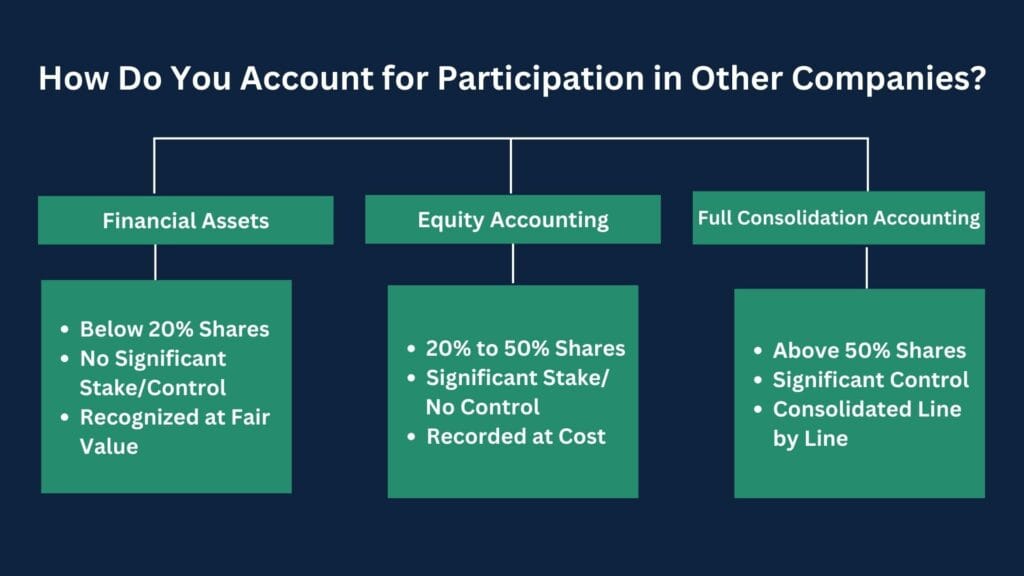
Ownership of more than 20% of a company’s voting stock generally indicates significant influence, requiring specific accounting treatment.
The equity method adjusts investment value based on the investor’s share of the investee’s profits, losses, and dividends.
It differs from full consolidation, which is applied when controlling more than 50% of a company, combining financial statements line by line.
Financial investments under 20% are typically valued at fair market value and classified as held-to-maturity, held-for-trading, or available-for-sale.
Using the equity method provides a clearer picture of economic interest, especially for joint ventures and substantial stakes without control.
Continuing with practical insights, this article explains how to implement and benefit from the equity accounting method for investments.
What Is the Equity Method of Accounting for Investments?
The equity method of accounting for investments is used when one company invests in another and has significant influence, but not total control, over that company. The benchmark for considering an ownership stake as a “significant influence” is typically between 20% to 50%. An investor owning 20% or more of an investee’s voting stock is presumed to have significant influence over the investee unless proven otherwise. Conversely, owning less than 20% suggests a lack of significant influence unless the investor can prove otherwise. Under the equity accounting method, the investment is first recorded at its original cost, and its value is then adjusted according to the investor’s share of the investee’s profits, losses, and dividends. The investing company records its investment through a method known as single-line consolidation, which manifests as a singular entry on its income statement, balance sheet, and cash flow statement.
Equity Accounting vs. Full Consolidation
The consolidation method and equity method of accounting for investments are two distinct approaches to reporting investments in other companies. Equity accounting is employed when a company has significant influence over another company but does not control it outright. Under this method, the investment is initially recorded at cost and subsequently adjusted to reflect the investor’s share of the investee’s net income or loss, which affects the investor’s balance sheet and income statement.
On the other hand, the consolidation method is used when a company has significant control over another company, usually indicated by owning more than 50% of the subsidiary’s voting stock. In this case, the parent company combines its financial statements with its subsidiary, line by line, effectively treating its assets, liabilities, income, and expenses as its own, eliminating intercompany transactions and balances. This approach provides a comprehensive view of the financial status of the combined entities as a single economic entity.
Equity Accounting vs. Financial Investments
If an investing firm owns less than 20% of another company, this ownership is classified as a financial investment. These are investments in entities over which the investor has no significant influence or control. They are considered passive investments and are classified into three categories:
- Held-to-Maturity: These are debt securities the investor has the positive intent and ability to hold to maturity. They are recorded at amortized cost.
- Held-for-Trading: These assets are acquired and sold shortly after to capitalize on short-term price fluctuations. They are valued at fair market value, and any changes in their value that have not been realized through sales are reflected in the profit or loss statement.
- Available-for-Sale: These are debt or equity securities not classified as either held-to-maturity or held-for-trading. They are recorded at fair market value, with unrealized gains or losses recognized in other comprehensive income until the investment is sold. At this point, the cumulative gain or loss is reclassified to profit or loss.
When accounting for financial investments in which an entity holds less than a 20% stake in another company, and there is an available market price, these investments are always valued at their fair market value on the balance sheet. This approach is part of the fair value accounting principle, ensuring that the investment reflects current market conditions and provides a more accurate and transparent view of an entity’s financial health. Such valuations affect the investment income and unrealized gains or losses, which are reported in the income statement or as other comprehensive income, depending on the classification of the investment.
In contrast, the equity method of accounting for investments involves adjusting the value of the investment based on the investor’s share of the investee’s profits or losses. The adjustment affects the investor’s net income and the carrying amount of the investment on the balance sheet.
Benefits of Using the Equity Accounting Method
The equity accounting method is significant for recording investments from equity-accounted companies. It accounts for stakes in companies you do not have control over. Here are the three main benefits of using this approach:
Account for Dividends
The equity accounting method is beneficial in accounting for dividends as it provides a more accurate reflection of the investment’s value and the investor’s share of the investee’s performance. Recognizing dividends received as a reduction in the carrying amount of the investment rather than income avoids double-counting of earnings. This method aligns the recognition of income with realizing the investment’s actual performance, ensuring that reported profits correspond more closely to the investor’s economic reality. Thus, equity accounting offers a more transparent, more realistic picture of an investor’s financial position and profitability, especially when the investor has significant influence over the investee.
Comply with the Applicable Accounting Standards
Using the equity accounting method helps companies conform to widely accepted accounting standards. In many jurisdictions, accounting frameworks such as the International Financial Reporting Standards (IFRS) and Generally Accepted Accounting Principles (GAAP) require the equity method for certain types of investments, particularly those where the investor has significant influence but not complete control over the equity-accounted company. Compliance with these standards is not just a matter of regulatory adherence but also signals to the market that the company is committed to transparency, reliability, and integrity in its financial reporting. It can enhance the company’s reputation among investors, lenders, and other stakeholders, leading to potential benefits such as improved access to capital and more favorable borrowing terms.
























































How the Equity Method of Accounting Method for Investments Work
An investment is an asset purchased with the intent of earning financial returns. This acquisition is strategically made to increase wealth through either the generation of income, such as interest, dividends, and rental earnings, or the appreciation of the asset’s value over time. To ensure an accurate representation of the investment’s contribution, it is essential to understand how the equity method of accounting for investments works.
The equity method of accounting for investments typically involves three steps:
- Recording the Purchase Cost
- Tracking Profits or Losses
- Value Adjustment on Financial Statements

Recording the Purchase Cost
When an investment is made, the purchasing company records the cost of acquiring the investment in its financial records. The equity method of accounting for investments establishes the base value of the investment on the investor’s books. It is done through a debit (increase) to investments from equity-accounted companies (or a similarly named account) on the balance sheet, reflecting the purchase price paid for the shares. Correspondingly, there is a credit (decrease) to cash or an increase in liabilities (if purchased on credit), depending on how the investment was financed.
Tracking Profits or Losses
After the investment is recorded, the investor accounts for its share of the investee’s profits or losses. It is not based on dividends received but on the investor’s proportionate share of the investee’s earnings or losses after the date of acquisition. For instance, when the investee generates a profit, the equity method of accounting for investments recognizes the investor’s proportionate share of these profits by debiting the investments from equity-accounted companies, indicating an increase in the investment’s value, and crediting the income investments from equity-accounted companies on the income statement, reflecting an increase in income.
Conversely, if the investee incurs a loss, the equity method of accounting for investments decreases (credits) investments from equity-accounted companies. It records a loss (debit) in the investments from equity-accounted companies. These adjustments align the investment account on the balance sheet with the investor’s share of the investee’s underlying net assets, reflecting the investor’s economic interest.
Value Adjustment on Financial Statements
The equity method of accounting for investments also requires adjustments to the value of the investment on the financial statements to reflect changes other than the investee’s profits or losses, such as impairments or additional investments. For instance, if the value of the investee decreases permanently below the carrying amount of the investment, an impairment loss is recognized. It involves decreasing (crediting) the investments from equity-accounted companies and recording an impairment loss (debit) on the income statement. Additionally, if the investor makes further investments in or receives dividends from the investee, these are adjusted against the carrying amount of the investment. Dividends received are treated as a return on investment and reduce (credit) the carrying amount of the investments from equity-accounted companies rather than recognizing dividend income in the income statement.
Through these steps, the equity method of accounting for investments provides a nuanced view of the investor’s stake in and earnings from its investee, offering a more accurate picture of the investor’s financial health and performance.
Equity Accounting Method Example
Let’s have a simple equity accounting method example under the following scenario:
- In Year 0, Company A invested $119,000 for a 20% stake in Company B.
- In Year 1, Company B reported a net income of $270,000 and paid dividends of $107,500.
- During Year 1, Company A does not buy or sell any more shares in Company B.
- In Year 2, Company B reported a net income of $290,000 and paid dividends of $115,000.
Effects on the Income Statement
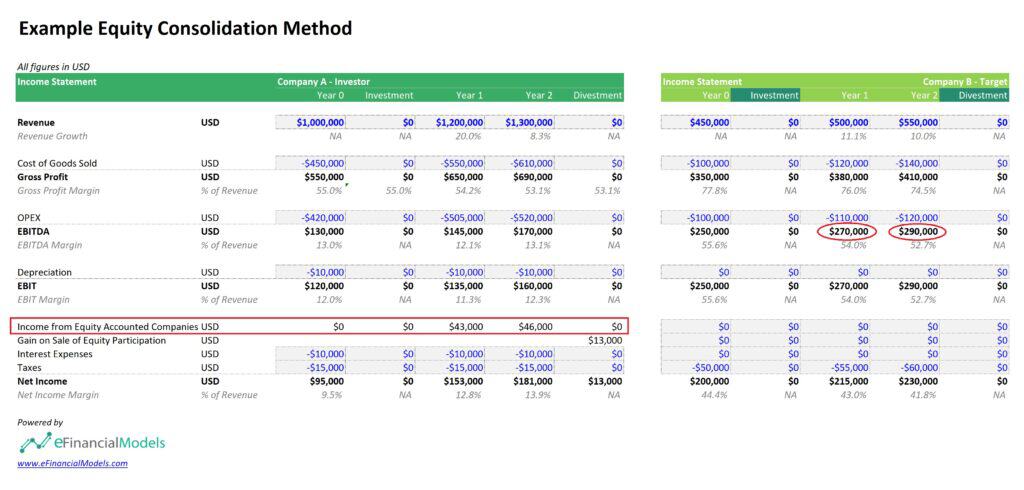
Under the equity method of accounting for investments, Company A accounts for its share of Company B’s profits or losses after the acquisition on the income statement. The income from equity-accounted companies shows Company A’s share of earnings from Company B as follows:
- Year 1 = $270,000 x 20% = $43,000
- Year 2 = $290,000 x 20% = $46,000
It is important to note that the income from equity-accounted companies is recorded below EBIT (Earnings Before Interest and Taxes) in the income statement primarily because the reporting entity (Company A) has no control over the equity-accounted investee. So, they do not directly increase the value of the investment. Similarly, it is also excluded from operating income and EBIT because it arises from investments outside Company A’s primary operations.
Effects on the Balance Sheet
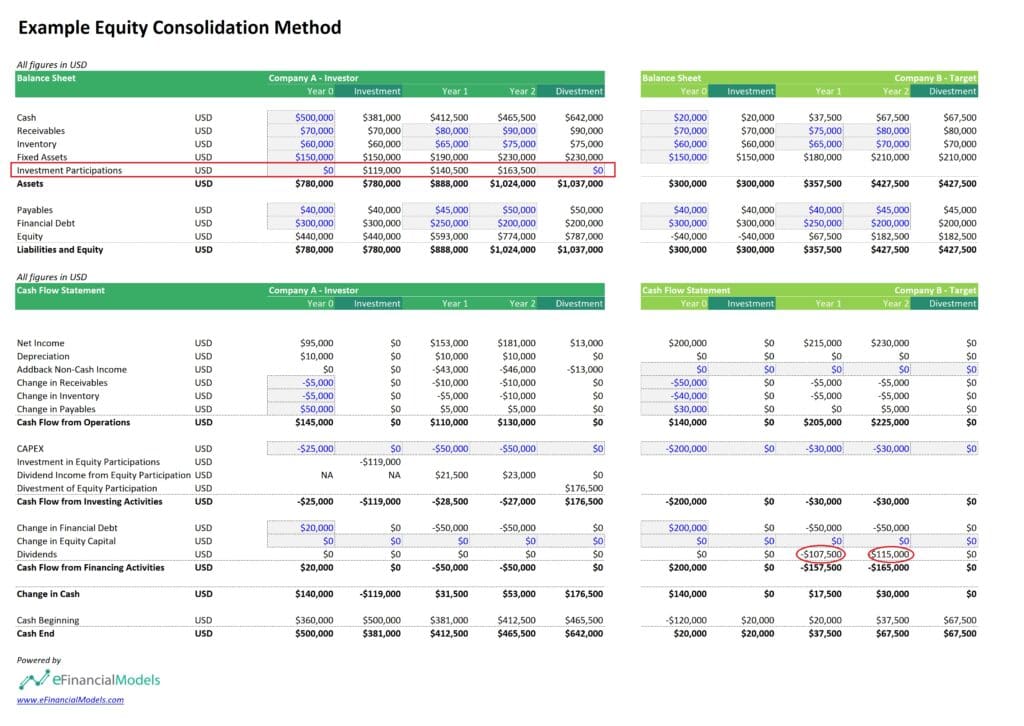
In the above equity accounting method example, Company A recorded its investment participation in Company B in the balance sheet at the base value upon investment ($119,000). Investment participation increased in Years 1 and 2 as Company B issued dividends, whereas Company A received 20%.
- Year 1 = $119,000 + ($107,500 x 20%) = $119,00 + $21,500 = $140,500
- Year 2 = $140,500 + ($115,500 x 20%) = $140,500 + $23,000 = $163,500.
These items increase Company A’s asset value in this equity accounting method example. Upon divestment, Company B’s investment participation dropped to $0, suggesting that all investments were divested (sold or liquidated).
Effects on the Cash Flow Statement
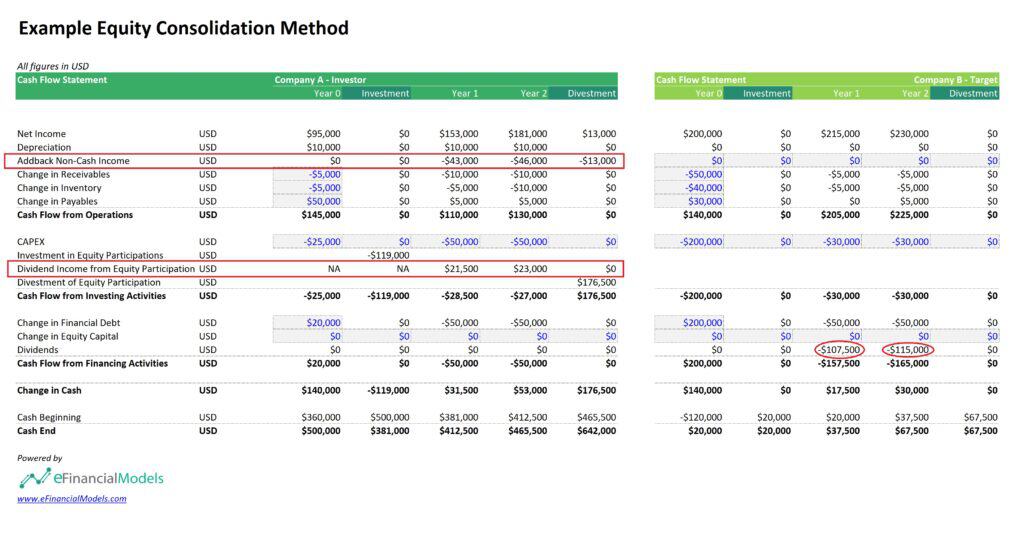
Under the equity method of accounting for investments, income from equity-accounted companies and gain on the sale of equity participation are treated as add-backs in non-cash income of the investor (Company A) within the cash flow from operating activities in the cash flow statement. This is because these earnings, while increasing reported net income, did not involve actual cash transactions. The investment in equity participation of $119,000 is recorded as a credit under the cash flow from investing activity because it represents an outflow of cash used to acquire the equity interest. The dividends paid by Company B or income from equity participation in Year 1 and Year 2 showed as debit under the cash flow from investing activity because it represents an inflow of cash received from the investment. Correspondingly, the divestment year shows a substantial cash inflow due to the sale of equity participation.
| Disclaimer: The above example was created from a financial modeling perspective. It simplifies real-world scenarios for illustrative purposes only, excluding complexities such as impairment, ownership changes, and dividends, and does not represent actual accounting records. |
Understand Investments with the Power of Equity Accounting
The equity method of accounting for investments is best utilized when the investing company has significant influence over the investee, typically interpreted as owning 20% to 50% of the voting stock. This method provides a more accurate representation of the investor’s economic interest in the investee, making it invaluable for companies engaged in joint ventures or holding substantial stakes in other companies without complete control or consolidation.
Incorporating financial models can significantly enhance the effectiveness of the equity method of accounting for investments. It offers a sophisticated framework for projecting future financial performance and assessing potential investment returns. These models can simulate how different market conditions, investment strategies, and economic scenarios may impact the value of the investment, as reflected in the equity accounting records. Through these models, investors can gain deeper insights into their investments, better align strategies with financial objectives, and, ultimately, enhance the value derived from their equity accounting practices.














































You might also like:
- 10 Main Elements of a Business Plan
- Steps to Building Financial Models in Excel
- Boost Your Business’s Financial Management with this Excel Budget Template
- 10 Tips to Develop a First Class Business Valuation Report
- 5 Best Practices for Managing Days Receivables
- 10 Ideas to Increase Average Revenue Per User
- How to Build a Capitalization Table
- Finding a Valuation Model for Your Business
- Financial Statements – Definition, Uses, Contents and Templates
- Pros and Cons of Equity Financing
- How to Calculate Net Present Value (NPV)?
- Understanding the Debt Service Coverage Ratio: An Essential Metric for Financial Analysis
- Understanding What is Yield to Maturity and Why It Matters
- Financial Model Templates Easy to Use
- Revenue Model Templates and their Characteristics
- How Contribution Margin Analysis Can Drive Your Business to Financial Success
- 3D Printing
- Funding Sources
- Business Valuation Service
Tags: Equity Accounting